
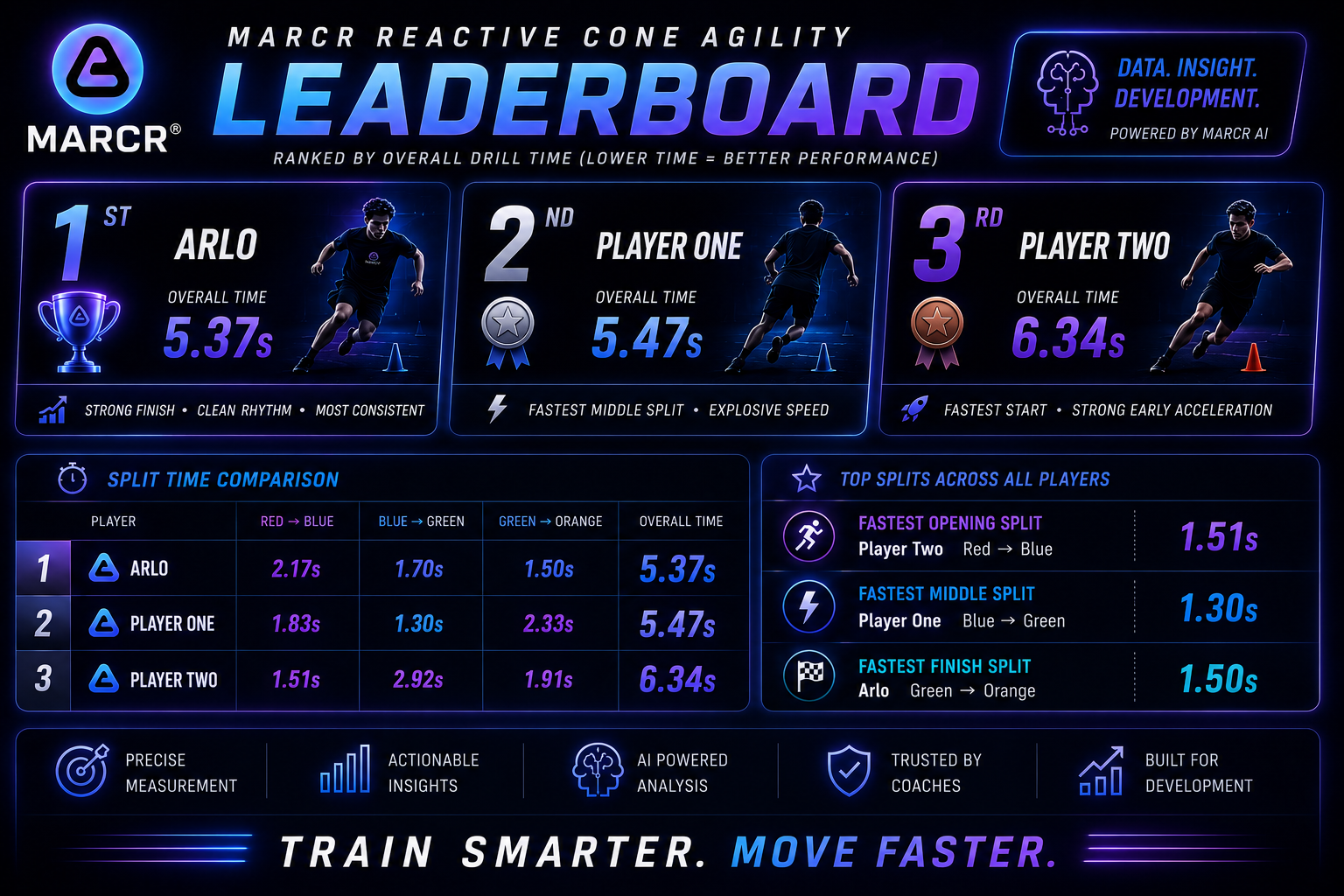

Marcr is a football training platform built to turn simple cone drills into measurable performance feedback. Using video analysis and intelligent movement tracking, Marcr helps players, coaches, and clubs better understand speed, agility, transitions, footwork, and decision-making during real training sessions. Designed for modern football environments, Marcr delivers practical athlete insights in a simple, coach-friendly format.
Player 1 - Arlo - Reactive Cone Agility Drill
Overall Time: 5.37 seconds
(Start = first explosive movement
Finish = final cone reached)
Cone Split Times:
Red to Blue 2.17s
Blue to Green1.70s
Green to Orange1.50s
Key Takeaways:
Strong Finish
Arlo got faster as the drill went on.
That’s a really good sign. It shows:
good endurance
improving rhythm
confidence building through the run
His fastest movement was: Green to Orange
Biggest Area To Improve:
Blue Cone Transition, this was the slowest and messiest part of the drill.
At the blue cone:
feet reorganised too much
extra steps were taken
exit wasn’t clean
This cost time.
What Arlo Did Well: Finished explosively; Movement became smoother through the drill; Strong acceleration late in the run; Good recovery after transitions
Coaching Focus
To Improve Time Quickly:
Attack the first cone harder
Take fewer steps at blue
Plant earlier and exit cleaner
Replicate the smooth rhythm from the final section earlier in the drill.
Marcr Core Metrics:
Arlo completed the drill in 5.37 seconds.
His first movement to the blue cone took 2.17 seconds, which was the slowest part of the run.
His change of direction was strongest at the green cone, but slower at the blue cone, where he took extra steps to reset.
His movement smoothness scored 84/100, showing that his rhythm improved as the drill went on.
Coach Summary
Arlo improved throughout the run instead of fading out. The biggest gain is cleaning up the blue cone transition. If he sharpens that turn, his overall time drops immediately.
Player One - Reactive Cone Agility Drill
Overall Time: 5.47 seconds
(Start = first explosive movement
Finish = final cone reached)
Cone Split Times:
Red to Blue 1.83s
Blue to Green 1.30s
Green to Orange 2.33s
Key Takeaways:
Fast Middle Section
Player One was quickest through the middle of the drill.
That’s a really good sign. It shows:
strong straight-line acceleration
confidence attacking space
ability to carry speed between cones
His fastest movement was: Blue to Green
Biggest Area To Improve:
Green Cone Transition, this was the slowest and messiest part of the drill.
At the green cone:
feet reorganised too much
ball stayed under the body too long
hesitation delayed the exit
movement rhythm broke down late in the run
This cost significant time.
What Player One Did Well: Strong acceleration through the middle section; Faster early splits than Arlo; Attacked the drill aggressively; Good pace carrying into blue and green transitions
Coaching Focus
To Improve Time Quickly:
Arrive at green under more control
Exit the green cone in two touches
Reduce hesitation after the turn
Maintain middle-section rhythm through the final segment
Keep the ball moving out in front instead of underneath the body
Marcr Core Metrics:
Player One completed the drill in 5.47 seconds.
His fastest split was Blue to Green at 1.30 seconds.
His slowest split was Green to Orange at 2.33 seconds, where the majority of time loss occurred.
His change of direction efficiency was strongest at blue, but slowed significantly at green where extra reset movements appeared before exit.
His movement smoothness scored 76.8/100, showing good attacking speed through the middle of the drill but reduced rhythm consistency late in the run.
Coach Summary
Player One was explosive through the middle of the drill and actually faster than Arlo across the first two sections. The biggest issue was the green cone transition, where hesitation and extra footwork slowed the final section heavily. If that green turn becomes cleaner and more decisive, overall time drops quickly.
Player Two - Reactive Cone Agility Drill
Overall Time: 6.34 seconds
(Start = first explosive movement
Finish = final cone reached)
Cone Split Times:
Red to Blue 1.51s
Blue to Green 2.92s
Green to Orange 1.91s
Key Takeaways:
Strong First Attack
Player Two started the drill quickly, then lost rhythm through the middle before recovering some speed late in the run.
That’s a really good sign. It shows:
explosive first movement
good acceleration ability
the main issue is technical rhythm, not effort
enough endurance to recover late in the drill
His fastest movement was: Red to Blue
Biggest Area To Improve:
Blue Cone Transition, this was the slowest and messiest part of the drill.
At the blue cone:
feet reorganised too much
body became too upright before exiting
ball stayed underneath the body too long
first movement toward green was delayed
This cost significant time.
What Player Two Did Well: Explosive launch off the start; Strong acceleration early; Recovered speed after the slow middle section; Cleaner exit off green than blue; Stayed committed through the full drill
Coaching Focus
To Improve Time Quickly:
Exit the blue cone in two touches
Open hips earlier before the turn
Keep the body lower through transition
Push the ball out in front earlier
Maintain rhythm through the middle section instead of resetting feet
Marcr Core Metrics:
Player Two completed the drill in 6.34 seconds.
His fastest split was Red to Blue at 1.51 seconds.
His slowest split was Blue to Green at 2.92 seconds, where the biggest time loss occurred.
His change of direction efficiency was strongest at the green cone and weakest at the blue cone, where extra reset movements slowed the exit.
His movement smoothness scored 72/100, showing a fast start, disrupted middle section, and cleaner rhythm late in the drill.
Coach Summary
Player Two is not losing time on the first attack. He is losing time in the blue-to-green section, where the transition becomes too busy and slows the whole run down. If the blue turn becomes cleaner and more decisive, the overall drill time drops immediately.